If you’ve ever searched for a product on Amazon and noticed listings marked ‘Sponsored’ at the top of the results — you’ve already seen Amazon PPC in action.
Amazon Pay-Per-Click (PPC) advertising is the engine that powers the visibility of millions of products on the world’s largest e-commerce marketplace. Whether you’re a brand-new seller trying to get your first sale or a growing brand looking to scale, understanding Amazon PPC is non-negotiable.
This guide breaks down exactly what Amazon PPC is, how it works, why it matters, and what the key metrics mean — no jargon, no fluff.
What Is Amazon PPC?
Amazon PPC (Pay-Per-Click) is Amazon’s advertising platform that allows sellers and vendors to run paid ads for their products. Advertisers bid on keywords, product categories, or specific ASINs, and pay Amazon a fee each time a shopper clicks on their sponsored ad.
The core idea is simple: you place a ‘bid’ for your ad to appear in a prominent position — like the top of search results or on a competitor’s product page. You only pay when someone actually clicks on your ad. If no one clicks, you pay nothing.
| 💡 Key Insight Amazon PPC is not just an advertising tool — it is also an organic ranking engine. Sales generated through PPC campaigns contribute to your product’s sales velocity, which Amazon’s A9/A10 algorithm uses to determine organic rankings. This creates a compounding flywheel effect. |
Why Does Amazon PPC Matter?
With over 350 million products listed on Amazon, organic discoverability alone is nearly impossible, especially for new or growing products. Amazon PPC solves this by giving you direct, controlled visibility.
Here’s why sellers invest heavily in Amazon PPC:
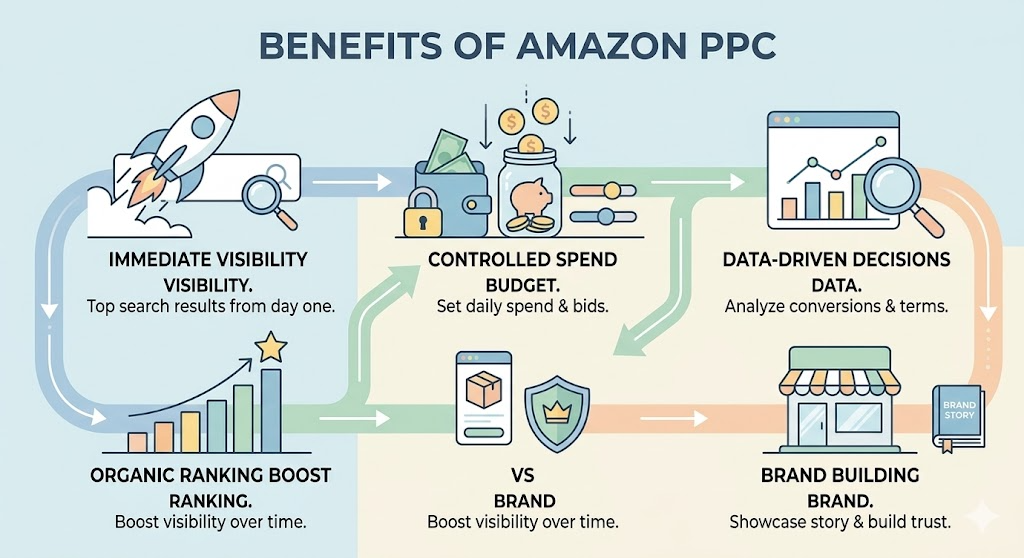
- Immediate Visibility: Your product appears at the top of search results from day one — no waiting months to rank organically.
- Controlled Spend: You set daily budgets and bids. You control exactly how much you spend.
- Data-Driven Decisions: Amazon PPC gives you rich data — search terms, click-through rates, conversion rates — that helps you understand your customer better.
- Organic Ranking Boost: Sales velocity from PPC-driven orders directly improves your organic search ranking.
- Competitive Conquest: You can run ads on competitor product pages, giving shoppers a reason to consider your brand over theirs.
- Brand Building: Sponsored Brands ads let you showcase your brand story, logo, and multiple products with a custom headline.
How Does Amazon PPC Work? The Auction Model Explained
Amazon PPC operates on a second-price auction model. Here’s how it works step by step:
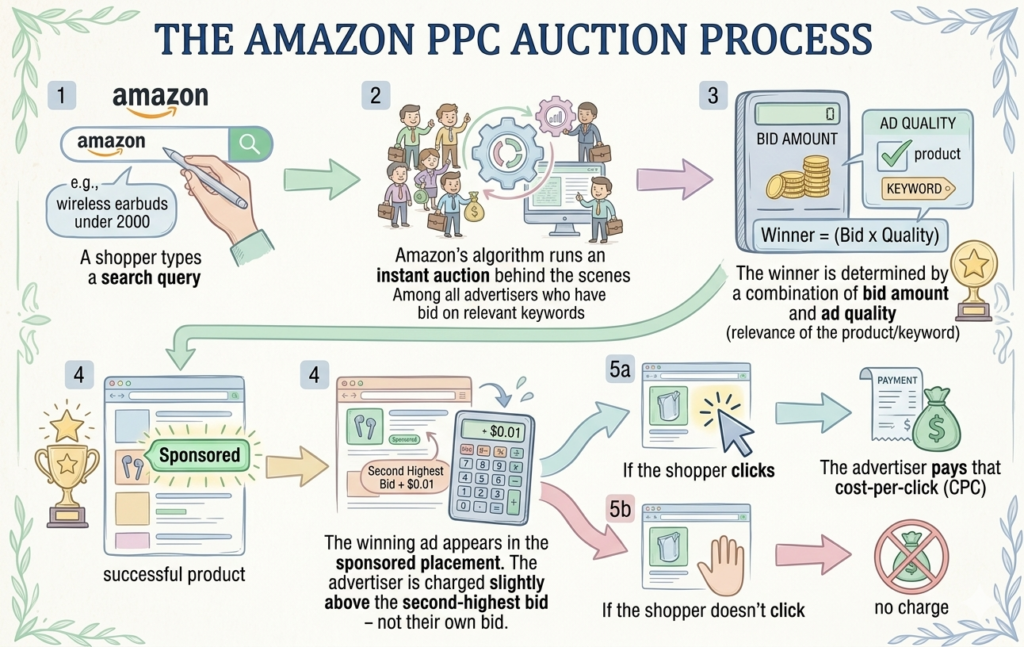
- A shopper types a search query into Amazon — e.g., ‘wireless earbuds under 2000’.
- Amazon’s algorithm runs an instant auction behind the scenes among all advertisers who have bid on relevant keywords.
- The winner is determined by a combination of bid amount and ad quality (relevance of the product/keyword).
- The winning ad appears in the sponsored placement. The advertiser is charged slightly above the second-highest bid — not their own bid.
- If the shopper clicks, the advertiser pays that cost-per-click (CPC). If the shopper doesn’t click, no charge.
| 🔑 The Second-Price Auction Explained If you bid ₹50 and your nearest competitor bids ₹35, you win the auction — but you only pay ₹36 (₹1 more than the second-highest bid). This makes aggressive bidding less risky than it seems. |
The Three Types of Amazon PPC Ads
Amazon offers three core ad types under its advertising platform. Understanding the differences is foundational to building any PPC strategy.
1. Sponsored Products (SP)
Sponsored Products are the most common and widely used ad type on Amazon. They appear within search results and on product detail pages, blending naturally with organic listings.
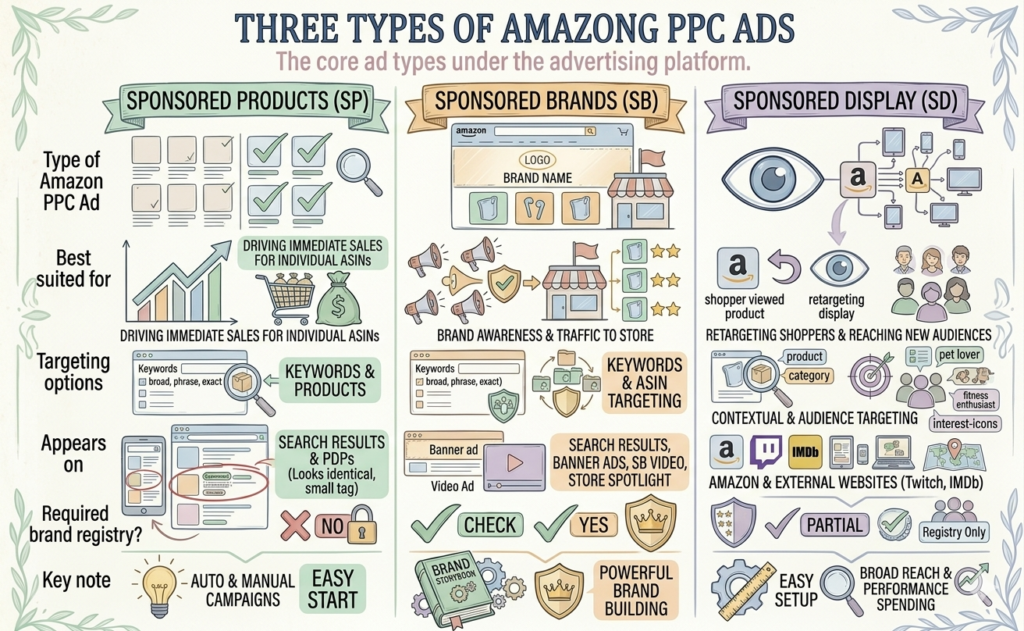
- Best for: Driving immediate sales for individual ASINs.
- Targeting options: Keywords (broad, phrase, exact) and product/ASIN targeting.
- Placement: Search results (top of search, rest of search) and product detail pages.
- Ad format: Looks identical to organic listings, with a small ‘Sponsored’ tag.
Sponsored Products come in two modes: Auto Campaigns (Amazon chooses your targets) and Manual Campaigns (you choose your targets).
2. Sponsored Brands (SB)
Sponsored Brands (formerly Headline Search Ads) are banner-style ads that appear at the top of search results, above the organic listings. They display your brand logo, a custom headline, and up to three products.
- Best for: Brand awareness, driving traffic to your storefront, and showcasing multiple products.
- Targeting options: Keywords (broad, phrase, exact) and ASIN targeting.
- Ad formats: Banner ads, video ads (SB Video), and Store Spotlight ads.
- Eligibility: Requires brand registry on Amazon.
Sponsored Brands are the most powerful tool for brand-building on Amazon. The custom headline allows you to communicate your unique value proposition directly to shoppers.
3. Sponsored Display (SD)
Sponsored Display is Amazon’s programmatic display advertising solution. It allows you to run ads not just on Amazon but also on third-party websites and apps through the Amazon DSP network.
- Best for: Retargeting shoppers who viewed your product but didn’t purchase, and reaching new audiences.
- Targeting options: Contextual (product/category targeting) and Audience (remarketing and interest-based targeting).
- Ad placement: Amazon product pages, search results, external websites, and apps (Twitch, IMDb, etc.).
- Eligibility: Available to all sellers (contextual); audience targeting requires brand registry.
| Ad Type | Best For | Appears On | Requires Brand Registry? |
| Sponsored Products | Direct sales for individual SKUs | Search results, PDPs | No |
| Sponsored Brands | Brand awareness, multi-product showcase | Top of search results | Yes |
| Sponsored Display | Retargeting, off-Amazon reach | Amazon + external sites | Partial |
The Key Amazon PPC Metrics You Must Know
Before you run a single campaign, internalize these metrics. They are the language of Amazon PPC.
ACoS — Advertising Cost of Sales
Formula: (Ad Spend ÷ Ad Revenue) × 100
ACoS tells you how much you’re spending in ads for every rupee (or dollar) of ad-attributed revenue. A 30% ACoS means you spent ₹30 to generate ₹100 in ad sales.
Lower ACoS = more profitable ads. However, the ‘right’ ACoS depends on your product’s profit margin. A product with a 60% margin can comfortably sustain a 40% ACoS.
TACoS — Total Advertising Cost of Sales
Formula: (Ad Spend ÷ Total Revenue [Ad + Organic]) × 100
TACoS is the big-picture metric. It measures your ad spend against your TOTAL revenue, not just ad-attributed revenue. As your organic ranking improves, your TACoS decreases — which signals that PPC is doing its job of building organic momentum.
| ⚡ Pro Tip TACoS is the healthiest long-term metric for evaluating your Amazon business. A declining TACoS with growing total sales means your organic presence is strengthening — this is the compounding flywheel every Amazon seller should be building toward. |
CPC — Cost Per Click
The amount you pay each time a shopper clicks your ad. CPC is driven by competition — more advertisers bidding on the same keyword = higher CPC.
CTR — Click-Through Rate
Formula: (Clicks ÷ Impressions) × 100
CTR measures how compelling your ad is. A low CTR (below 0.3–0.5%) suggests your main image, title, price, or ratings aren’t convincing shoppers to click. Benchmark: a healthy Amazon CTR is typically 0.3–0.5%+.
CVR — Conversion Rate
Formula: (Orders ÷ Clicks) × 100
CVR tells you what percentage of shoppers who click actually buy. A low CVR (below 3%) signals listing quality issues — weak images, poor A+ content, uncompetitive pricing, or insufficient reviews.
Impressions
The number of times your ad was displayed. Low impressions suggest your bids are too low, your budget is capped, or your targeting is too narrow.
| Metric | What It Measures | Red Flag |
| ACoS | Profitability of ad spend | Above your break-even ACoS |
| TACoS | Overall ad efficiency vs. total sales | Rising despite growing ad spend |
| CPC | Cost per ad click | Rising significantly month-over-month |
| CTR | Ad appeal / listing quality | Below 0.2% |
| CVR | Listing quality / shopper intent match | Below 3% |
| Impressions | Visibility / reach of ads | Near zero (bid/budget issue) |
The Break-Even ACoS: The Number That Runs Your Business
Your Break-Even ACoS is the maximum ACoS you can sustain without losing money on ad sales. Calculate it as:
| 📐 Formula Break-Even ACoS = (Selling Price – COGS – Amazon Fees – Fulfillment Costs) ÷ Selling Price × 100 Example: If your product sells for ₹1,000 and your total costs are ₹600, your profit margin is ₹400, or 40%. Your break-even ACoS = 40%. Any ACoS above 40% means you’re losing money on every ad sale. |
At the launch phase, it’s acceptable to operate above your break-even ACoS intentionally. You’re paying for visibility and organic ranking. As organic sales ramp up, you optimize to bring ACoS within — and eventually below — your break-even.
Auto vs. Manual Campaigns: What’s the Difference?
Auto Campaigns
In an Auto Campaign, Amazon’s algorithm decides which search terms and ASINs to show your ad against, using your product listing as its reference. You set a bid and a budget, and Amazon does the targeting.
The four targeting sub-types in Auto campaigns are:
- Loose Match: Keywords loosely related to your product.
- Close Match: Keywords closely related to your product.
- Substitutes: Product pages of similar/competing products.
- Complements: Product pages of complementary products.
Auto campaigns are essential for discovery — they surface search terms you wouldn’t have thought of, which can then be migrated into high-performing Manual campaigns.
Manual Campaigns
In Manual Campaigns, you choose exactly which keywords or ASINs to target. This gives you full control over relevance, bids, and spend allocation.
Manual campaigns use three keyword match types:
- Broad Match: Widest reach. Amazon shows your ad for search terms that contain your keyword in any order, including synonyms and variations.
- Phrase Match: Your keyword must appear in the search term in the same order. More targeted than broad.
- Exact Match: Your ad only appears when the search term matches your keyword exactly. Most precise and highest quality clicks.
What Factors Affect PPC Performance Beyond Bids?
This is where most beginners go wrong: they think Amazon PPC performance is purely a function of how much you bid. In reality, your listing quality determines the ceiling of your PPC performance.
Amazon’s algorithm rewards relevance. Products with strong listings convert better, which earns them better ad placement even at lower bids. Before scaling any PPC campaign, audit these factors:
- Pricing competitiveness vs. category average
- Main image: white background, zoomable, high resolution
- 4+ total images on the product detail page (PDP)
- At least 2 infographic images showing product benefits
- At least 1 lifestyle image showing product in use
- 5 detailed bullet points in the listing
- A+ Content (EBC) live on the listing
- Minimum 4-star rating with 15+ reviews
- Correct browse node / category
| ⚠️ Warning Pumping ad spend into a listing with a poor main image, no reviews, or uncompetitive pricing is like pouring water into a leaking bucket. Fix the listing first, then scale the ads. No amount of PPC budget overcomes a bad product page. |
Frequently Asked Questions
How much does Amazon PPC cost?
Amazon PPC has no minimum spend. You set your daily budget (as low as ₹50 or $1/day) and your bids. You only pay when someone clicks. Average CPC varies by category — from ₹5 to ₹150+ in India and $0.20 to $3+ in the US.
Do I need a brand registry to run Amazon PPC?
No — Sponsored Products are available to all sellers without brand registry. Sponsored Brands and full Sponsored Display audience features require brand registry (Amazon’s IP protection program).
How long does it take to see results from Amazon PPC?
You can see impressions and clicks within hours of launching a campaign. Meaningful performance data typically emerges within 2–4 weeks. Organic ranking improvements from PPC-driven sales velocity take 4–8 weeks to become visible.
What is a good ACoS for Amazon PPC?
There’s no universal ‘good’ ACoS — it depends entirely on your product’s profit margin. A healthy guideline: your ACoS should be below your break-even margin. For new launches, an ACoS of 30–80% can be acceptable temporarily as you build velocity and organic rank.
Can Amazon PPC help with organic ranking?
Yes — this is one of the most powerful (and underutilized) benefits of Amazon PPC. When your ads generate sales, Amazon’s algorithm interprets this as demand signal for your product, which improves your organic search ranking over time.
Conclusion: PPC Is a System, Not a Switch
Amazon PPC is not a button you press and forget. It’s a dynamic system that rewards sellers who understand the interplay between listing quality, keyword relevance, bidding strategy, and continuous optimization.
The fundamentals you’ve learned in this guide — ad types, key metrics, auto vs. manual campaigns, and the listing factors that make or break PPC performance — are the foundation of everything that follows.
In the next post in this series, we’ll go deep on Amazon PPC match types — the exact mechanics of how Broad, Phrase, Exact, and ASIN targeting work, and how to use each strategically.
| 📚 Next in the Series Post 2: Amazon PPC Match Types: The Complete Breakdown — Everything you need to know about Broad, Phrase, Exact, Auto sub-types, ASIN targeting, Cross-sell and Up-sell campaigns. |
Leave a Reply