This is the post for sellers who’ve moved past the basics. You understand ACoS and TACoS. You’ve built campaign structures. You’re managing a healthy account. Now you want the edge — the integrated, systems-level thinking that separates top 1% Amazon advertisers from the rest.
This master guide synthesizes the complete Amazon PPC Mastery Series into one integrated framework, adds advanced concepts not covered in previous posts, and gives you the strategic mental models to make decisions that compound over time.
Part 1: The Mental Model of Amazon PPC
Before tactics, understand the model. The way you think about Amazon PPC determines the quality of every decision you make.
Amazon PPC Is an Investment, Not a Cost Center
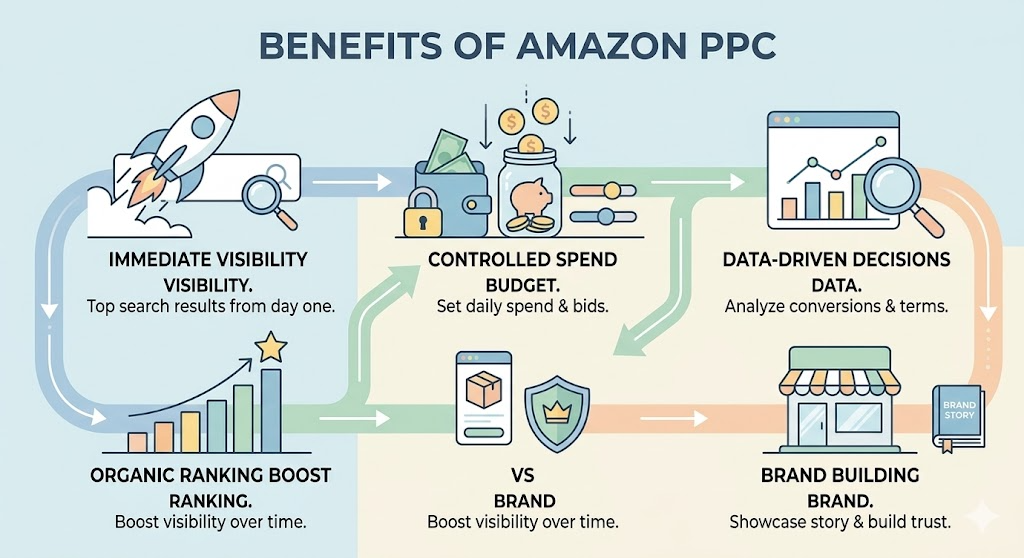
When you view PPC as a cost, you optimize to minimize it. When you view PPC as an investment, you optimize to maximize the return — which includes both direct ad revenue and the organic ranking it builds over time.
The most successful Amazon sellers accept intentional periods of high ACoS (even above break-even) as strategic investment in organic positioning. They understand that the ₹50,000 spent this month at 70% ACoS is building the organic rank that will generate ₹3,00,000 at 0% ACoS over the next 12 months.
Amazon’s A9/A10 Algorithm: What PPC Is Really Doing
Amazon’s search ranking algorithm (commonly referred to as A9, more recently A10) uses sales velocity, conversion rate, click-through rate, and relevance as primary ranking signals. Here’s the critical insight:
PPC-driven sales count identically to organic sales in Amazon’s algorithm. Every order generated by a Sponsored Products ad contributes to your product’s sales velocity, which improves your organic search rank, which generates more organic sales, which improves your BSR, which generates more clicks at zero ad cost.
Understanding this flywheel transforms how you think about ad spend: you’re not just buying sales — you’re buying algorithm signals.
| 🧠 The Algorithm Investment Thesis Invest PPC budget most aggressively when: 1. You have a new product that needs velocity to rank organically 2. You’re entering a seasonal peak where ranking gains compound 3. You have a product with high repeat purchase rate (the organic rank value is multiplied by LTV) 4. Competitors are weak (low reviews, poor listings) — ranking jumps are easier and faster Pull back when: 1. Organic rank is strong and defending itself 2. Category competition is increasing prices without conversion improvement 3. Cash flow requires profitability optimization |
Part 2: Brand Analytics — The Data Layer Most Sellers Miss
Amazon Brand Analytics (available to brand-registered sellers) is the most underutilized tool in Amazon’s arsenal. It provides data that no third-party tool can replicate because it comes directly from Amazon’s transaction records.
Search Query Performance Report
The Search Query Performance report shows, for every keyword your brand is receiving impressions on: your click share (% of all clicks you captured), conversion share (% of all purchases you captured), and your rank vs. competitors.
Strategic applications:
- Identify keywords where you have high impression share but low click share → CTR problem → fix main image or price.
- Identify keywords where you have high click share but low conversion share → CVR problem → fix listing or A+ content.
- Identify keywords where competitors have high conversion share → your strongest keyword-level competitive threats.
- The keywords where you have the highest click share are your strongest organic ranking opportunities — double down in PPC for these terms.
Market Basket Analysis
Market Basket Analysis shows which products Amazon customers most frequently buy alongside your product. This is the data source for your cross-sell and up-sell campaign targeting.
Strategic applications:
- Identify your top 5 market basket ASINs → Target these in SP Manual cross-sell and up-sell campaigns.
- If a competitor product appears in your market basket → Run SD Complement targeting on those competitor ASINs.
- If your own catalog products appear in each other’s baskets → Build product bundle strategy and dedicated cross-sell SP campaigns.
Repeat Purchase Behavior
This report shows what percentage of your customers repurchase your product within defined time windows (30, 90, 180 days).
Strategic applications:
- High repeat purchase rate products justify higher ACoS investment at first purchase — customer LTV is high.
- Run SD Purchases Remarketing specifically for past buyers approaching their repurchase window.
- Consider Amazon Subscribe & Save enrollment for consumable products with high repeat purchase rates.
Top Search Terms by Category
This report shows the top 1,000 most-searched terms in your product category each week. Use this to:
- Identify emerging search trends before competition increases (first-mover advantage in keyword targeting).
- Monitor seasonal search volume shifts to plan campaign budget increases.
- Identify keywords with high search volume where your product isn’t ranking — target aggressively in PPC.
Part 3: Advanced Bidding Techniques
The Segmented Campaign Strategy for Exact Match
As your account matures, create separate Exact Match campaigns organized by performance tier:
- Tier 1 (Champions): Keywords with CVR > 8% and ACoS < 50% of target → Highest bids, Dynamic Up & Down, TOS priority.
- Tier 2 (Contenders): Keywords with CVR 4–8% and ACoS 50–100% of target → Medium bids, Dynamic Down Only.
- Tier 3 (Prospects): Keywords with < 4% CVR or ACoS > target → Lowest bids, Fixed, monitoring for improvement.
This tiering ensures your highest-value keywords never compete for budget with underperformers within the same campaign.
The Dayparting Strategy
Amazon’s bid schedule (available in Amazon Marketing Console for DSP, and indirectly via rules in campaign manager) allows adjusting bids by time of day. For most categories, conversion rates vary significantly by hour — peak shopping hours typically see 2–3× the conversion rate of off-peak hours.
Use your order history data (by hour) from Seller Central to identify peak conversion windows, then set bid adjustments to maximize spend during these windows.
The Competitor Weakness Targeting Playbook
This advanced technique uses competitive intelligence to identify the weakest competitor listings in your category and concentrate ASIN targeting there:
- Use Helium 10 Blackbox with these filters: Category = your sub-category; Monthly Sales > ₹5L (competitive product with traffic); Images < 3 (weak listing quality); Reviews < 50 (limited social proof).
- Export the resulting ASIN list.
- Create a dedicated SP Manual campaign targeting these ASINs (Exact ASIN targeting).
- Set bids 20–30% higher than your category average CPC — you want to win these placements aggressively.
- Monitor conversion rate from this campaign. Products with weak listings convert their traffic to competitors at high rates — your goal is to capture this switchable traffic.
This technique can deliver some of the lowest CPAs in your entire account because you’re intercepting already-interested shoppers at a competitor’s weakest point.
Part 4: Seasonal and Event-Based PPC Strategy
Amazon’s sales calendar has defined peak events — Big Billion Days, Great Indian Festival, Prime Day, Diwali, Republic Day Sale, and more — that dramatically shift search volume, competition, and conversion rates. Your PPC strategy must shift with them.
Pre-Event Preparation (4–6 Weeks Before)
- Increase campaign budgets by 30–50% to build organic ranking ahead of the peak (more PPC velocity → better organic rank entering the event).
- Launch new campaign types you haven’t tested yet — the high traffic volumes make data accumulation faster.
- Ensure ad creative assets (banners, videos) are refreshed and event-specific.
- Stack coupons and deals on your top products — the combination of promoted listings + PPC ads + deals creates compounding visibility.
During the Event
- Increase bids on your highest-converting Exact Match keywords by 30–50%. Competition increases, but so does customer intent.
- Monitor hourly budget utilization — campaigns can exhaust daily budgets within hours during peak events. Increase budgets aggressively.
- Enable TOS placement bid adjustments on your best-performing campaigns.
- Pause low-performing targets immediately — during peak traffic, every rupee of wasted spend is costing you more than usual.
Post-Event Strategy
- Don’t immediately cut budgets. The post-event period often has elevated conversion rates as deal shoppers return for items they didn’t buy during the event.
- Review event performance data within 48 hours — which keywords, campaigns, and ad types drove the most efficient sales?
- Migrate any new high-performing search terms discovered during the event into your Exact Match campaigns.
Part 5: The Integrated PPC-SEO Framework
The most advanced Amazon advertisers understand that PPC and SEO (organic ranking) are not separate strategies — they are two components of a single integrated growth system.
Phase 1: Keyword Seeding (Weeks 1–4)
Run broad-reach PPC campaigns (Auto + Broad/Phrase Manual) to drive initial sales velocity across a wide set of keywords. This creates initial ranking signals for many keywords simultaneously.
Phase 2: Keyword Consolidation (Weeks 4–8)
Identify which keywords from Phase 1 generated the most sales. Concentrate PPC spend on these keywords via Exact Match campaigns while pulling back on low performers. You’re consolidating ranking energy into the highest-potential keywords.
Phase 3: Organic Rank Defense (Month 3+)
For keywords where your product has achieved Page 1 organic rank (positions 1–16), switch to Fixed Bids at lower amounts. You’re now using PPC defensively — maintaining position and capturing branded search — while organic does the heavy lifting.
Phase 4: Expansion (Ongoing)
While defending your core keyword rankings, use Auto and Broad Match campaigns to continuously discover new keyword opportunities. The system is always in discovery mode in the long tail while defending and scaling in the short tail.
| 🔄 The PPC-SEO Flywheel (Summary) PPC Spend → Sales Velocity → Organic Rank Improvement → Organic Sales Growth → Lower TACoS → More Budget for PPC Expansion → More Sales Velocity → Repeat This flywheel is the core of every successful Amazon brand’s growth engine. The fuel is ad spend. The output is compounding organic equity. |
Part 6: Multi-Marketplace PPC Strategy
For brands operating across Amazon India, Amazon US, and other international marketplaces, PPC strategy requires marketplace-specific adaptations:
Amazon India (IN) Specifics
- CPC is significantly lower than US marketplace — use this to test aggressive campaign structures at lower cost.
- Mobile-first marketplace: Main image quality and price prominence are amplified. Optimize ruthlessly for mobile thumbnail.
- Tier 2/3 city demand has different search behavior — include regional language transliterations in backend keywords.
- Quick Commerce cannibalization: Track whether your Amazon sales are being impacted by Blinkit/Zepto/Swiggy Instamart for applicable categories.
Amazon US (and Global) Specifics
- Significantly higher CPCs — campaign efficiency optimization is more critical.
- More sophisticated competition — product differentiation and listing quality have higher impact on performance.
- Amazon DSP (Demand Side Platform) is more mature and offers advanced programmatic options beyond campaign manager.
- Brand Registry benefits are more powerful — leverage all Sponsored Brands video and stores features aggressively.
Part 7: Building a Reporting System That Drives Decisions
Reports don’t drive decisions — systems that surface actionable insights from reports do. Here’s the complete reporting architecture:
Daily Report: Trailing 7-Day Runrate
Purpose: Catch acute problems before they compound.
- Daily ad spend vs. daily target.
- Total daily sales (PPC + Organic) vs. daily sales target.
- Any campaigns with sudden ACoS spikes (> 2× yesterday’s ACoS).
- Any campaigns hitting budget cap before 12 PM local time.
Weekly Report: WoW Performance
Purpose: Track week-over-week performance trends.
- Sales: This week vs. last week, same week last year.
- Ad Spend: This week vs. last week.
- ACoS and TACoS: This week vs. last week, vs. target.
- Top 5 campaigns by sales, Top 5 by spend.
- Organic vs. Paid revenue split trend.
Monthly Report: Full Business Review
Purpose: Strategic evaluation and course correction.
- Total Sales vs. Monthly Target.
- TACoS vs. Monthly Target.
- Budget Utilization: Was the full ad budget deployed? Where was it under/over-utilized?
- Organic Sales as % of Total Revenue (trend).
- Top 10 Keywords by Sales (organic rank, ad rank, CVR).
- SKU-Level Performance: Top 3 and Bottom 3 performers with diagnosis.
- BSR Movement: Average BSR this month vs. last month for top 10 ASINs.
- Action Plan: 3–5 specific actions for next month based on data.
Part 8: Common Advanced Mistakes (And How to Avoid Them)
Mistake 1: Keyword Cannibalization
When the same keyword appears in multiple campaigns with different match types, campaigns compete against each other in the auction — driving up your own CPCs.
Fix: Use campaign-level negative exact keywords to segment match types. If a keyword is in your Exact match campaign, add it as a Negative Exact to your Broad and Phrase campaigns.
Mistake 2: Ignoring Impression Share
High spend with flat impressions means you’re not winning enough auctions. This happens when your bids are competitive but budget runs out early in the day.
Fix: Check campaign delivery reports. If budget is exhausted before 3 PM, increase daily budget first, then adjust bids.
Mistake 3: Scaling Broken Campaigns
Increasing budget on a campaign with structural issues (wrong targeting, wrong bidding strategy) just means more waste at higher volume.
Fix: Audit campaign structure before scaling. Follow the 4-stage diagnosis framework before touching budgets.
Mistake 4: Ignoring SD Remarketing
Sponsored Display audience remarketing is the most consistently underutilized campaign type in Amazon PPC. Studies show 60–70% of Amazon shoppers browse a product 2–3 times before purchasing.
Fix: Launch a Views Remarketing SD campaign for every product with > 50 daily detail page views. Start with a small budget (₹200–500/day) and optimize based on ROAS.
Mistake 5: Not Using Negative Targeting Proactively
Most sellers add negatives reactively (after wasted spend). Proactive negative seeding prevents waste before it happens.
Fix: At campaign launch, pre-populate campaigns with obvious negative keywords: competitor brand names you don’t want to appear for, irrelevant category terms, price-sensitive terms (‘cheap’, ‘free’, ‘second hand’), size/variant terms you don’t sell.
The One-Page Amazon PPC Decision Framework
When you’re looking at an underperforming campaign or SKU and need to decide what to do, use this decision framework:
- Check Impressions: Low impressions → Visibility Problem → Check bids, budgets, listing browse node, keyword indexing.
- Check CTR: Low CTR (< 0.3%) → Click Problem → Fix main image, price, rating, targeting relevance.
- Check CVR: Low CVR (< 3%) → Conversion Problem → Fix A+ content, reviews, additional images, pricing.
- Check ACoS: High ACoS with good CTR/CVR → Bid Problem → Apply scenario-based optimization rules.
- Check TACoS: Rising TACoS → Organic not growing → Assess keyword indexing, listing SEO, velocity strategy.
- Check Organic Sales %: Flat organic % → PPC not converting to organic equity → Reassess keyword strategy and concentration.
Frequently Asked Questions
When should I consider Amazon DSP vs. campaign manager?
Amazon DSP (Demand Side Platform) is for brands spending $10,000+ monthly and wanting programmatic advertising beyond what campaign manager offers: custom audience segments, frequency capping, off-Amazon retargeting with full creative control, and advanced reporting. For most sellers, campaign manager + Sponsored Display covers 90% of use cases.
How do I know if my PPC is building organic rank or just renting sales?
Track your organic keyword ranking weekly using Brand Analytics Search Query Performance. If your top 10 organic rankings are improving month-over-month while total sales grow, PPC is building organic equity. If organic rank is flat despite consistent PPC spend, your velocity isn’t translating to ranking — likely due to listing quality, review count, or relevance issues.
What’s the biggest lever for improving Amazon PPC performance?
The single highest-leverage activity for most accounts is systematic negative keyword management combined with weekly search term report mining. Reducing wasted spend by 20% through negatives and migrating 5–10 new converting search terms per week into Exact Match campaigns compounds dramatically over 90 days.
Is Amazon PPC worth it for private label vs. wholesale brands?
Both, but with different strategies. Private label brands own their listing and can invest in A+ content, brand registry features, and long-term ranking building — PPC has the highest ROI for private label. Wholesale brands often can’t edit listings and may lack brand registry access — focus PPC on Sponsored Products with exact match keywords and ASIN targeting for the SKUs you carry.
Conclusion: Build Systems, Not Campaigns
The trailblazer insight in Amazon PPC is this: every individual campaign decision is only as good as the system it sits within. A single great campaign doesn’t make a great account. A systematic approach to discovery, testing, optimization, and compounding — applied consistently over months and years — is what builds category-defining Amazon businesses.
The sellers who dominate their categories on Amazon aren’t the ones with the biggest budgets. They’re the ones with the best systems.
Use this master guide as your reference architecture. Revisit it quarterly. Update it as Amazon’s advertising platform evolves. And most importantly, implement it — systematically, consistently, and patiently.
The Amazon PPC flywheel is the most powerful growth engine in modern e-commerce. Now you know how to build one.
| 🏆 This concludes the Amazon PPC Mastery Series 8 posts. Complete coverage from beginner to trailblazer. From ‘What is PPC?’ to advanced algorithm strategy, Brand Analytics, seasonal playbooks, and multi-marketplace frameworks. Save this series. Share it with your team. Return to it when you need a framework for any Amazon advertising challenge you face. |